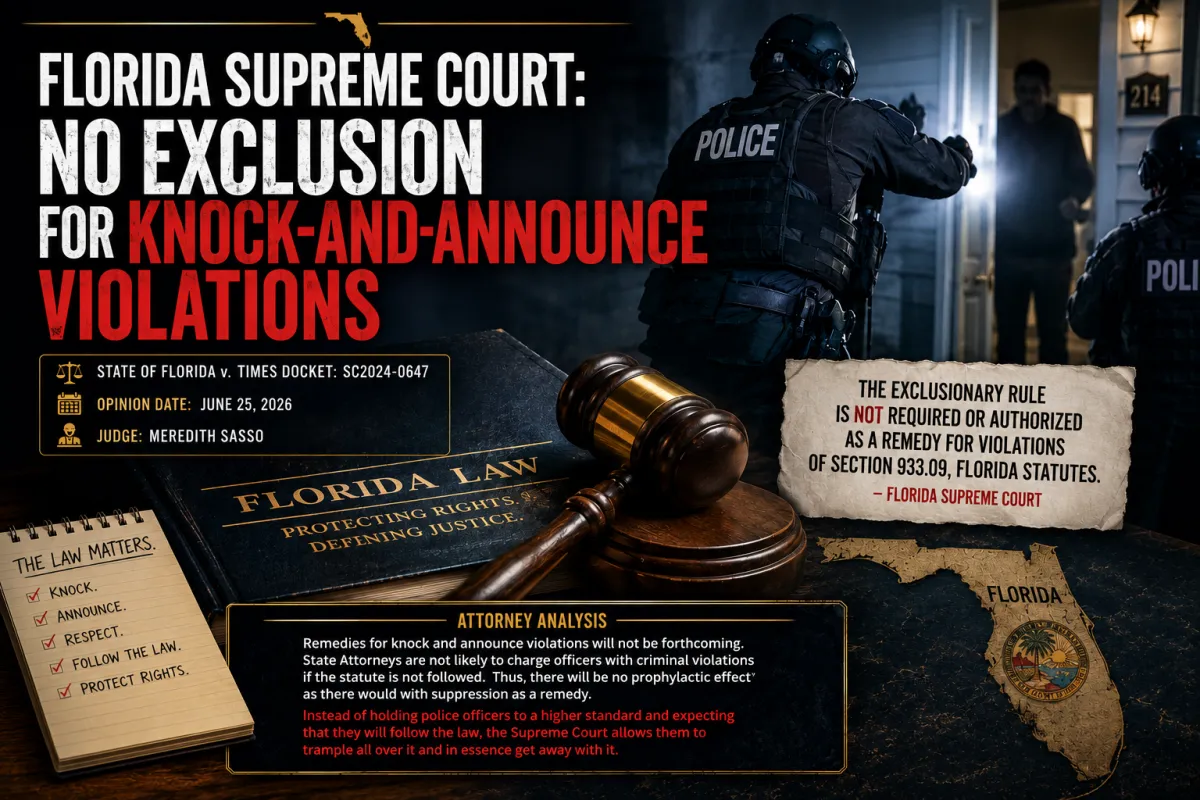
Florida Supreme Court Ends Suppression for Knock and Announce
Reviewed by Michael P. Maddux, Esq. | Board Certified Criminal Trial Lawyer | Florida Super Lawyer for 16 Consecutive Years
In State of Florida v. Times Docket: SC2024-0647, Opinion Date: June 25, 2026, Judge: Meredith Sasso
Law enforcement officers, investigating a suspected drug trafficking operation, obtained a valid search warrant for a residence in Leon County, Florida. When executing the warrant, officers knocked and announced their presence but only stated they had a search warrant seconds before forcibly entering the home. Several individuals, including the respondent, were inside, and officers found drugs, cash, and firearms. The respondent was charged with multiple offenses, including drug trafficking and possession of a firearm by a convicted felon.
The respondent filed a motion to suppress the evidence, claiming a violation of section 933.09, Florida Statutes, which requires officers to knock and announce their authority and purpose before forcibly entering a home. The Circuit Court for Leon County granted the motion, relying on Florida Supreme Court precedent from State v. Cable, which required exclusion of evidence for such statutory violations. The State appealed, but the First District Court of Appeal affirmed, emphasizing it was bound by Cable. The First District, however, certified a question to the Florida Supreme Court, highlighting conflicting approaches in other jurisdictions after the United States Supreme Court decision in Hudson v. Michigan, which held that the federal exclusionary rule does not apply to knock-and-announce violations under the Fourth Amendment.
The Supreme Court of Florida reviewed the certified question and determined that the exclusionary rule is not required or authorized as a remedy for violations of section 933.09, Florida Statutes. The court receded from its prior decision in Cable, holding that because the statute does not provide an exclusionary remedy and instead prescribes criminal penalties for violations, courts should not impose suppression of evidence. The Florida Supreme Court quashed the First District’s decision and remanded for further proceedings consistent with its ruling.
ATTORNEY ANALYSIS: Remedies for knock and announce violations will not be forthcoming. State Attorneys are not likely to charge officers with criminal violations if the statute is not followed. Thus, there will be no prophylactic effect as there would be with suppression as a remedy. Instead of holding police officers to a higher standard and expecting that they will follow the law, the Supreme Court allows them to trample all over it and in essence get away with it.
