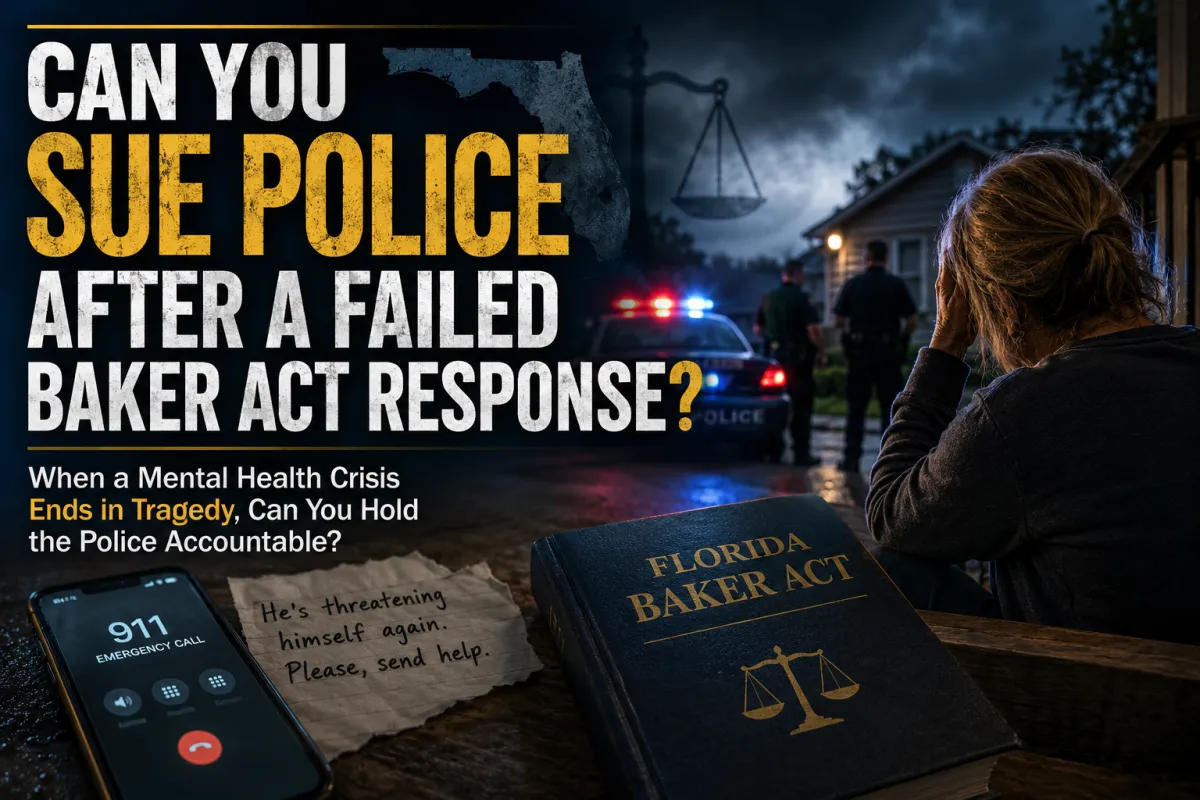
Can You Sue the Police for Not Helping During a Mental Health Crisis? A Florida Court Says No
Reviewed by Michael P. Maddux, Esq. | Board Certified Criminal Trial Lawyer | Florida Super Lawyer for 16 Consecutive Years
A recent court ruling shows how hard it can be for families to hold police accountable when a loved one dies after officers decided not to intervene in a mental health emergency.
Imagine you call 911 multiple times because someone in your family is threatening to hurt themselves. Officers come, talk to your family member, and leave — telling you there's nothing they can do. Then your family member dies that night. Can you sue the police?
A Florida appeals court recently answered that question, and the answer was no.
What Happened
A mother called 911 several times in one day because her adult son — who had schizophrenia — was making suicidal threats, had taken too many of his prescription pills, and sent text messages suggesting he intended to harm himself.
Officers responded, spoke with him, and decided he didn't meet the legal standard for an involuntary mental health hold under Florida's Baker Act — a law that allows police to take someone to a mental health facility against their will if that person poses a serious risk of harm to themselves or others. The officers left. They referred the family to the police department's mental health crisis team, but gave the family incorrect information about when that team was available.
The man was found dead the next morning, less than a block from his family's home. He died of a drug overdose.
His mother filed a lawsuit against the city, arguing the officers were negligent — that they didn't do their jobs properly and that their actions (and inaction) contributed to her son's death.
What Is the Baker Act?
The Baker Act is a Florida law that allows police officers, doctors, and mental health professionals to have someone involuntarily taken to a mental health facility for evaluation if that person appears to be a serious danger to themselves or others.
Importantly, the Baker Act gives officers theauthorityto act — but it doesn'trequirethem to. Whether to initiate a Baker Act is a judgment call.
The Two Big Legal Questions
The lawsuit raised two main legal issues.
The first: did the officers owe the man a legal duty of care? In other words, were they legally responsible for his safety?
In Florida, police generally owe a duty to the publicas a whole, not to any specific individual. There are exceptions — for example, if officers take someone into custody, or if their actions make a dangerous situationworse— but courts are careful about when those exceptions apply. The family argued this situation was like a prior Florida Supreme Court case where officers conducted a welfare check on an unresponsive woman, wrongly concluded she was just sleeping, and she died. In that case, the court said officers did owe a duty of care. The city argued this was different — that deciding whether to Baker Act someone is a law enforcement function that courts shouldn't second-guess.
The second question: even if a duty existed, are police protected bysovereign immunity? Sovereign immunity is a legal concept that protects the government from being sued for certain types of decisions — specifically, big-picture policy choices that require judgment and expertise. The idea is that courts shouldn't be in the business of substituting their judgment for the judgment of police officers and government officials. The family argued the officers were justcarrying outan existing policy (not creating it), so immunity shouldn't apply.
What the Court Decided
The trial court sided with the city and threw out the case before it ever went to a jury. The appeals court agreed.
The courts found that: (1) deciding whether someone meets the Baker Act criteria is a law enforcement function for which officers do not owe a duty to any specific person; and (2) even if they did owe a duty, their judgment calls on the scene were the kind of discretionary decisions that sovereign immunity protects.
The case never went to a jury. The family never got a trial.
Why Does This Matter?
This case is a window into one of the hardest areas of the law: what happens when government fails someone during a mental health crisis. Florida courts have consistently said that police can't be held liable just because they made a judgment call that turned out to be wrong — even tragically wrong.
That doesn't mean every case like this is unwinnable. The facts matter enormously. Whether officers took custody of someone, made the situation worse, gave misleading information that caused the family to stop seeking help — all of those things can change the legal analysis.
Think You Have a Case?
If your family has been harmed after police failed to respond appropriately to a mental health crisis, the law in this area is complex and fact-specific. The attorneys at theLaw Office of Michael P. Maddux, P.A.handle civil rights and personal injury claims throughout Florida and can help you understand your options.
